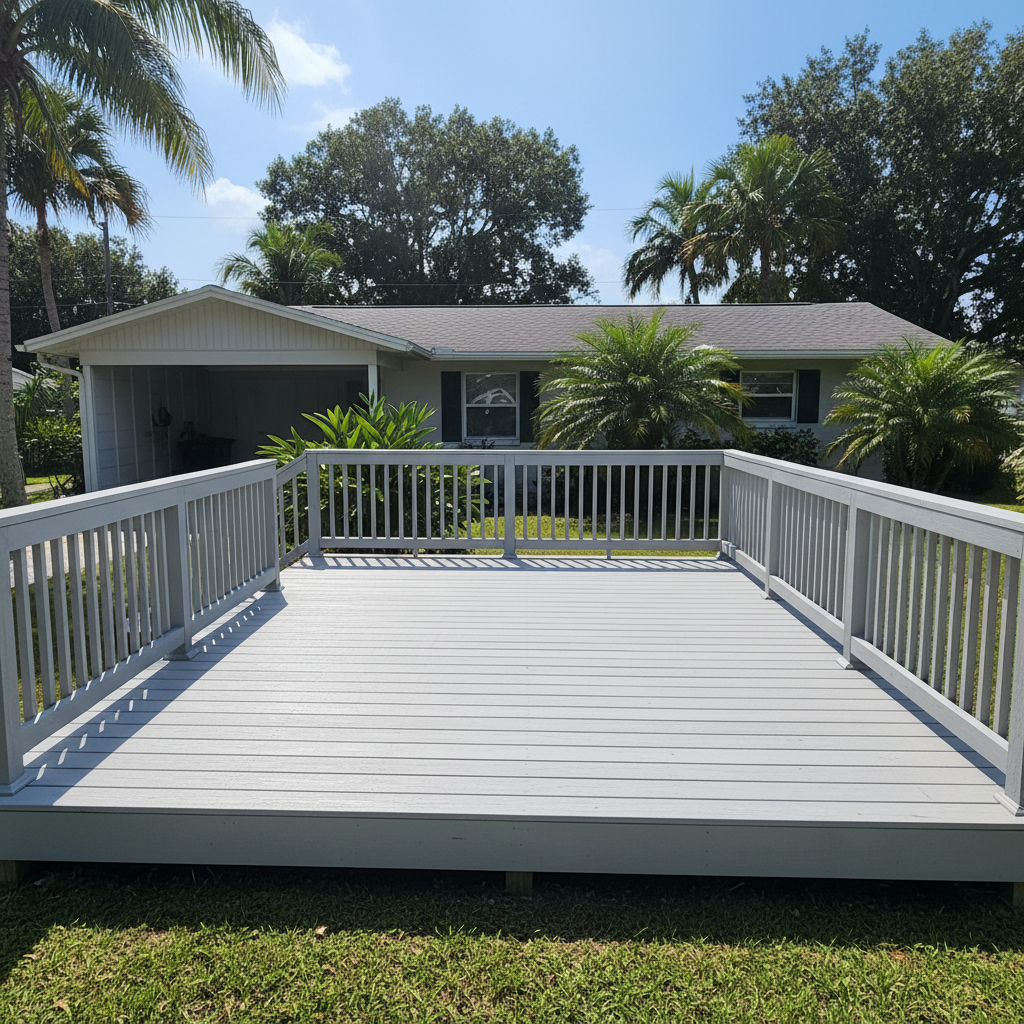
Every deck builder in this county will tell you they do good work. That's not useful information. What's useful is knowing what good work actually looks like on the ground here, so you can spot the difference between a contractor who builds for this climate and one who's just putting up the same deck he'd frame in Ohio.
Port Charlotte sits low and flat, a lot of it on sandy soil that drains fast, with a water table that comes up close to the surface on canal lots and anywhere near Charlotte Harbor. That changes how footings get set. It changes how fast a post rots if the wrong wood touches the ground. And the six months of hurricane season, June through November, change what hardware should be holding your deck to the house. A builder who's worked other states but is new to this one may not know any of that. Ask questions that find out.
License and insurance, actually checked
Florida requires a license for deck construction, either a certified or registered contractor license through the state, or a local competency license depending on the scope of the job. Ask for the license number and look it up yourself on the Florida DBPR website. It takes two minutes. Also ask for a certificate of insurance showing general liability and workers' comp, and have it sent to you directly rather than taking someone's word for it. If a deck collapses or a worker gets hurt on your property and there's no coverage, that liability doesn't just disappear, it tends to land on the homeowner.
A contractor who hesitates on either of these is telling you something. Walk away. You don't need the drama of finding out why six months later.
Permits aren't optional here, no matter what you're told
Charlotte County requires a building permit for most deck construction, and for anything attached to the house or built more than a couple feet off grade, that permit comes with inspections. Typically that means a footing inspection before concrete goes in, a framing inspection before decking boards go down, and a final once railings and stairs are complete. If your property backs up to a canal or seawall, setback rules get checked too, since a lot of these lots were platted decades ago with narrower buffers than you'd see in newer subdivisions.
Some of the older sections of Port Charlotte, platted by the Mackle brothers back in the 1950s and 60s, have lots with concrete block homes already close to the property line, which makes setback math tighter than it looks. Newer developments further out toward Murdock or North Port tend to have more room to work with, but may carry deed restrictions through an HOA that also wants to approve the design before the county ever sees the permit application.
If a builder tells you permits are a waste of time or that it's faster to skip it, that's the clearest red flag in this whole business. An unpermitted deck is a problem when you sell the house, a problem for your insurance if there's storm damage, and a problem if the county finds it during an unrelated inspection. The permit fee is small money next to all of that.
Materials and hardware that actually survive here
Pressure-treated pine is still the standard framing material, but not all of it is the same. Ground-contact rated lumber should be used anywhere a post meets soil or concrete, not the lighter above-ground rated stuff, because that distinction matters once humidity and sandy, often damp soil get involved. For the fasteners, standard galvanized screws corrode fast against the copper compounds in modern treated lumber. Stainless steel or hot-dip galvanized hardware rated for ACQ treated wood is what should be going into your deck, not whatever was cheapest at the box store that week.
Composite decking has gotten popular here for a good reason, it doesn't need the recoating that wood does in this sun, but it still needs a frame built to the same standard underneath, and it still expands and contracts more than wood in our summer heat, so gaps and fastening need to account for that. A builder who treats composite decking like it's maintenance-free from the frame down is cutting a corner you won't see until it telegraphs through the boards a few years later.
Footings matter more here than people expect, because it's not about frost depth like it is up north, Florida doesn't really have a frost line to dig below. It's about wind uplift. Post anchors should be rated for the wind loads in the Florida Building Code for this zone, and that's not a detail to take on faith. Ask what the post spacing is and what anchors are specified. A deck that looks fine in April should still be standing after the first named storm in September.
What the contract should actually say
A one-page estimate scribbled on a invoice pad is not a contract. It should spell out the square footage, the decking material by brand and product line if it's composite, the framing lumber grade, the fastener type, start and completion windows, and a payment schedule tied to milestones rather than one big deposit up front. Florida law caps how much a contractor can legally ask for before work begins in some cases, and a legitimate builder will know that number without you bringing it up.
Get the warranty in writing too, separate from the manufacturer's warranty on the decking material itself. Workmanship and material warranties are two different things, and a builder who conflates them on purpose is hoping you won't ask which one covers a sagging joist versus a faded board.
Red flags worth walking away from
- No physical address, just a cell number and a Facebook page.
- Pressure to sign the same day, especially after a storm when deck and roof damage brings out a lot of fly-by-night crews.
- A quote dramatically lower than two or three others for the same scope, same materials.
- Reluctance to pull a permit or vague answers about who's doing it.
- No mention of hurricane strapping or wind-rated hardware when you ask directly.
None of this is complicated, it just takes asking a few direct questions instead of going with whoever answers the phone first. A deck built right for this stretch of Florida should hold up through salt air, sandy soil, summer downpours and whatever comes through in hurricane season without needing to be rebuilt in five years. If you want to see how we handle permitting, footings and materials on a project in Port Charlotte, take a look at Nova Deck Co and what we build.